Thursday, September 29, 2005

Airport No


Do you all remember this poster from 1970 ?

It may be time to print them up again folks. The government is not making a final decision on the airport in Pickering until 2009, but they may already be laying some ground work with the Pickering Airport Site Zoning Regulations If you can understand this, your better then I am. It looks like a lot of smoke and mirrors.
People or Planes

Wednesday, September 28, 2005

Life in a Small Town

Cherrywood Store and Life in Cherrywood 1928 ---1942
Written by Bob Morrish September 2005

This story covers some history about Cherrywood and Cherrywood store and many of the things that I can remember from when I lived there in the nineteen twenties, thirties and forties. I also obtained information from conversations and letters from people who lived in Cherrywood during the same time-- Mac & Elizabeth Armstrong, Emily Pearse (Petty), Mary Brown (Somerville), Phyllis Cockburn (Gates), John & Mary Teefy, Don Stewart, Merna & Betty Burkholder and my brothers and sister. I obtained most of the history from Helen Alves daughter of Agnes Alves ( Petty) and John Sabean of the Pickering historical society.

THE STORY

The store and the dwelling where the Roy Morrish family lived was built in 1872 by Charles Petty, a pioneer and entrepreneur who also built and operated Cherrywood brick yard and owned and operated a farm in the village. Charles Petty never operated the store, but leased it to various storekeepers. Some of the storekeepers were Williams,Cranson,Murray Summerfelt, Alfred McPherson, John Green, Tom Robins,Thomas Law, Robert Davidson and our father Roy Morrish who leased and operated it from 1921 until 1935.From 1929 to 1935 Our mother, Ella, and father, Roy also owned and operated a store in Pickering. They also owned a barber shop which was leased to Chester Butt, the village barber. In 1935 the Cherrywood store became available for outright purchase so our Mother and Father decided to buy it. Running the two stores, one in Pickering and one in Cherrywood was becoming too much work so they leased the store in Pickering to Ross Murison and a Mr. Booth. One or two years later Booth & Murison bought the store in Pickering. Our mother & father bought the dwelling and store in Cherrywood from the Petty estate in 1935 . The old barn and ice storage shed were demolished and the barn was rebuilt to make it more efficient for handling feed and coal and providing protection for the trucks and car. The store was rebuilt and a new dwelling was built on to the west side of the store The business included a coal storage shed and scales, first along side the Canadian Northern Railway in Cherrywood , and when the Canadian Northern was abandoned (I believe in 1929), the coal shed and scales were moved to the south side of the tracks opposite the Canadian Pacific Railway station in Cherrywood and the business was served by Canadian Pacific.
There was no hydro power in Cherrywood untill 1929. Before 1929 lighting was provided by coal oil lights, naptha gas lights and wax candles. We had two coal furnaces for heating . Our kitchen stove was fueled by wood or coal untill 1929 and when electricity was installed we had a combination wood and coal stove for cooking . We had ice refrigerators untill 1936. The ice was cut and hauled from Whitevale pond and stored

in an ice house behind the barn. A deep covering of saw dust prevented the ice from melting througout the summer. Depending on the weather, usualy every , a block or two of ice was removed from under the saw dust and placed in a compartment in the top of the refrigerator. Perishable foods were stored in the bottom of the refrigerator.
We did not have indoor plumbing untill 1936 when our new house was built beside the store.
The store and facilities at Cherrywood provided most of the things needed by the people of the community and surrounding farms,--groceries, tea, coffee, dry goods like, linens, overalls, socks, boots, shoes, school supplies,hardware, ice cream, pop,candies, tobacco & cigarettes, coal, wood, feed for cattle, horses, pigs, mink,dogs and cats and binder twine for harvesting grain. Our father did the buying of all of the goods and transporting them from Toronto to Cherrywood by truck and rail.He usually made two trips to Toronto a week to do the buying and picking up. This job was usually done on Mondays and Thursdays.Some of the wholesalers were groceries from National Grocers, the hardware from H.S. Howland, the dry goods from Gordon McKay, boots and Shoes from W.B. Hamilton and Lyle Reed, tea and coffee from R.B. Hayhoe, and the feed from Western Canada Flower Mills who were later bought out by Master Feeds. Feed was also bought from ReesorÂ’s Marmill in Markham and corn gluten feed from St. Lawrence Starch Co. in Port Credit.
Our mother, (who was a partner in the business) and Beatrice Petty who worked in the store,(and later Mary Tool, Isobel Tran, Blanch Petty, Carol Armstrong) were reponsible for obtaining orders (mostly by phone) for the various things the customers wanted. Mary Tool, Isobel Tran, Blanche Petty, Esther Reesor, and Carol Armstrong also worked at various times for our Mother , helping with household chores and in the store. All of us had a hand in putting the orders together in boxes and stocking the shelves. Fred Ireson did the delivering and helped with many of the other chores that were required to run the store. Before Fred Bo Bonner and later Jim Fenney did this work. . Delivering was done in the north east area of the community on Tuesdays, the north west and south west on Wednesdays and the south east on Thursdays. Special deliveries of coal and feed were done whenever we had time during the week, mostly on Fridays, Saturdays and Mondays. Occasionaly in winter, the country roads were not passable for trucks and cars. In this situation deliveries were made by our Uncle Murray Milroy who owned a farm a few miles from the store-and also by Walter Holmes and Henry Michelle who owned nearby farms—using their sleighs and his teams of Clydesdale horses.
Bill, Jack and I did some of the delivering and picking up things in Toronto,-( mostly coal and feed) when we were old enough to drive a truck.In the 1930Â’s we had two trucks. The larger truck was used to pick up goods in Toronto and for delivering large orders of coal and feed , and the other for delivering groceries and smaller orders of grain and feed. Some of the trucks that I remember were a 1926 model T Ford, a 1928 model A Ford 2 ton stake body, a 1930 panel body Ford pick up for the store in Pickering, a 1934 V eight Ford 3 ton stake body. These vehicles were later traded in on newer models to do the same work. Our Father and Bill never kept trucks or cars long enough for maintence or reliability to become a problem. Some of the cars that I can remember were a 1926 model T Ford, a 1928 Pontiac, a 1935 Pontiac, and a 1939 Pontiac.

Bill started to work full time at the store in 1950. He and Irene took over ownership and the operation of the store in 1959 when they bought it from our mother and father.
The property and store was expropriated to make way for a new airport-( which was never built)- in 1972. Under agreementent with the government , Irene and Bill continued to operate the store untill 1977 when they negotiated the sale of the store and property to the Government. The store was also the post office . Our father was the postmaster untill 1971 and Bill was the postmaster from 1971 to 1977.
All of us,--Mary Anna, Bill, Jack and I were expected to do our share of household and yard chores, like washing dishes,sweeping up,cutting the grass, weeding, washing trucks and cars, maintaining the tennis court, flooding the ice and removing snow from the pond and tennis court where we played hockey .
Cherrywood, from 1872 untill 1972,-( when the whole area was expropriated to make way for an airport which was never built) was a small village with a church, school, carriage shop, blacksmith shop, garage, cider mill, butcher shop and grocery store. In the 1870Â’s Charles Petty built a brick yard and kilns and he and his son operated the industry untill it was closed down in the 1920.s.
The surrounding farms were considered to be part of Cherrywood. Cherrywood public school area was bounded by the Township line on the west, the 4th concession road on the north, Dixie road on the east, and the 2nd concession on the south,. The school was across the road from the store. Anybody wishing to extend their education beyond grade 8 went to Continuation school at Pickering to get a Junmatrixtric. To obtain a senmatrixtric you took grade 13 at Whitby , Scarborough or Markham.
Most of the recreational activities evolved from the family house and back yard , the school, the Sunday School, the Church,--in the Milroy, Armstrong and Taylor farm barns-doing things like jumping into a pile of hay or straw from as high a place in the barn that you would dare, --skating on frozen ponds, skiing on nearby hills, swimming in Duffins creek, the Rouge river and Lake Ontario. There was radio, but no TV and no computers. favoriterite radio programs were the play by play hockey games by Foster Hewitt with between period commentatorsWes McKnight, or Ward Cameron, Harold Cotton and Elmer Ferguson. favoriterite Sunday nite programs were Jack benny with his usual cast of wife Mary Livingston,Rochester, Dennis day, and Phil Harris. The humour evolved around BennyÂ’s violin, his old Maxwell car, his skin flint approach to everything and his continual feud with Fred Allen. The Fred Allen show was also popular with his trips down AllenÂ’s Alley with his wife Portland and running into characters like Mrs.Nussbaum, Senator Claghorn,and Titus Moody. Fibber MÂ’Gee and Molly was popular on Tuesday nites ,particularly when they opened the closet to try and find something . Jim Hunter broadcast the news at 6:30 p.m. each evening followed by Wes McKnight with the sports news.
Everybody in the community was given the opportunity and encouraged to participate in all recreational activities that were taking place, -- softball, hockey, skiing, fishing, tennis, swimming, horseshoes, golf and card games.
There were card games around our kitchen table in the home, at the school and in the garage next to the store. Jack occasionally played cards in the garage with a group of card players rather than do his home work. We had a tennis court in our back yard which was

popular summer activity for all of us, our family, our friends and our neigbours. Tennis competitions were held involving a tennis team from Pickering and players from Cherrywood. Horseshoes were played on the horse shoe pitch (4) across the road from
the store. The community horse shoe pitch replaced the old cider mill. There were 4 sets of pitches with lights and horse shoe competitions were held which invoved surrounding communities like Whitevale and Cedar Grove. In later years when interest in horse shoes declined, the horse shoe facilities across the road were replaced with a single pitch between the store and the garage next door. Our father took us and our friends to Rice Lake, Georgian Bay and Cameron Lake to swim and fish.
Cherrywood had hockey and softball teams which competed in organized leagues with teams from the surrounding villages, Whitevale, Brougham, Pickering, Kinsale, Dunbarton, Markham, Agincourt, and Highland Creek. The manager –coaches and best fans and supporters of our hockey teams were our father, Len Gates, and Bill Davidson and later Jim Palmer. Recreational hockey was played on the tennis court, and the brick yard pond and the organized hockey was played on the indoor rinks at Markham and Agincourt.
The nearest pubs were located on the 1st concesion road at the Rouge river—one in the valley and the other at the top of the west bank of the river. They were meeting places where you got together with your friends and talked over current local events ,sports etc. and drank some beer. Jim McGrisken and Bobbie Miller were usually there to keep us up to date on everything. Jim knew all the local gossip. Bobbie, from Whitevale never said anything but always nodded in agreement to anything that was said. No one ever knew what Bobbie did for a living and for some reason he always had money for beer.
Sunday School was mandatory in our family and most of the other families in the community. We had to go to Sunday school before we were allowed to do other things like swimming, playing tennis or hockey. The Sunday school and church people
organized many activities includin Sunday school picnics, church garden parties and church concerts. Our father was one of our Sunday school teachers. I do not believe he knew a lot about the bible but was a good role model and highly respected in the community. He was also a school trustee and had a hand in making sure we always had a good school teacher. As a Sunday school teacher,(and as a father)—and like most other people in the community at that time, you were expected you to know the difference between right and wrong, have a positve and winning attitude, respect for other people and their property, expected obedience, excellence and perfection and and made sure everybody in our class participated in all the sports that were going on in the community. Our mother, Ella, a school teacher, had these same qualities and had the time to teach us more about humility, joy and happiness , cleanliness, thankfulness, good manners and sharing.
Along with her parental responsibilities and working in the store, she was active in the Church , Sunday school and community events. She was a Sunday school teacher, very active in the Church Ladies Aid, ocassionally played the piano in Sunday school, the organ in church, and sang in the church choir, and occasionally a relief teacher at the school. She was active in organizing events at the school, card parties and square dancing. Our grandmother Milroy also played an important role in our lives right up

untill she died in the 1963. Her wit, smile, laugh and positive attitude will always be emembered.
After finishing high school Bill, Jack, Mary Anna and I were encouraged and given the opportunity to go on and obtain further training. Bill took a business course at Ryerson College in Toronto, Mary Anna graduated in nursing at Wellesley hospital in Toronto and
then a University degree in nursing from the University of British Columbia and Jack and I graduated with degrees in Civil Engineering from University of Toronto. After finishing high school and not able to get into the air force because I was color blind, our uncle Murray Morrish, a mechanical Engineer, a graduate from the University of Toronto encouraged me to become an Engineer and took the time to take me on a tour of the Engineering faculty at U.of T., and of Hart House, the building which was the centre of most of the extra curricular activities for men at the University. The building had rooms and facilities for swimming, basketball, gymnasium, pool hall, card rooms,a library , restaurant and a large ballroom for dancing .
In Cherrywood like most other small rural farm communities strict rules and guide lines were taught at home, in the school, and in the Sunday school. There was no interference by governments and no worries about being politically correct. School inspectors came around a few times each year to make sure the teacher was doing O.K. regarding his teaching responsibilities. On those days the teacher usually directed his questions to the smartest kids in the class. On those days I could relax. If punishment was needed at home or in the school, suitable punishment was given. including the strap. Most of the school teachers of that era were tough and usually fair . There was little tolerance for misbehavior and there was much more discipline than there is to-day. This, along with everyone having an opportunity to be continually active physically ,and, or, mentally, there was usually harmony and fun in the home and in the community.

Thanks Bob. GREAT Story !

Tuesday, September 27, 2005

Morrish's in Cherrywood


Most of you that are were around Cherrywood when I was, would remember the Morrish's running the store. Here is a bit of history as to how they ended up there.

Cherrywood U.F.O.

Dennis Prophet's life was changed when he saw his first UFO. An RCAF veteran and the operator of an automobile dealership in West Hill, near Pickering, a town east of Toronto, Prophet had no interest in unidentified flying objects until 16 January 1974. That was the night that he experienced his first sighting. "When you've seen what I have seen and what my family has seen, you've got to believe", he explained.

It was the sight of an oval, orange glowing object in the sky toward the east that excited him. He was talking with an employee on a cold night outside his West Hill dealership when they saw the UFO.
It was at an altitude of about 1,500 feet. It appeared to be hovering over the Cherrywood Hydro lines in Pickering, Ontario. After watching it hovering there for about 10 minutes, we noticed it coming closer to us. As it came closer, we observed a ribbon of light that appeared to be revolving on the top, which indicated that it had some form of cabin or observation tower on the top of it.

To define more clearly the ribbon of light, it appeared like a miniature rainbow revolving around the top of an observation deck. While hovering, it maintained the same altitude. Being an extremely cold night, the employee suggested that we step back into the showroom and for other reasons I felt the same way.
While observing the object at very close range for a further 5 minutes, we saw it slowly begin to rise, accelerating in a spiral pattern to an altitude of some 4,000 to 4,500 feet, where it stopped for a moment, hovering, then started to move across the sky to the north.

The object was observed for a further 10 minutes by my employee and another witness, my wife. I had called home and asked her to look into the sky to see if she could spot the object, which she did for some 10 minutes as it headed in a northerly direction still at an altitude of about 4,500 feet. The whole sighting lasted from 11 p.m. to 11.25 p.m. It seemed in the range of a quarter of a mile away.

That was simply the first in a series of sightings many of which were spotted in the vicinity of the Pickering nuclear power plant.

Saturday, September 24, 2005

Charles Petty's brick & tile Kiln, c1910


1.& 2. The Kilns were built about 1858 and were last fired in 1918. After Charles Petty's death in 1903, the kilns were run by his son Charles K. Petty. In the main photo are Oscar Petty, Charles Lintner & George Gates.
3. Drainage tile believed to have been made at the brickworks
4. Cherrywood postmark.

Thursday, September 22, 2005

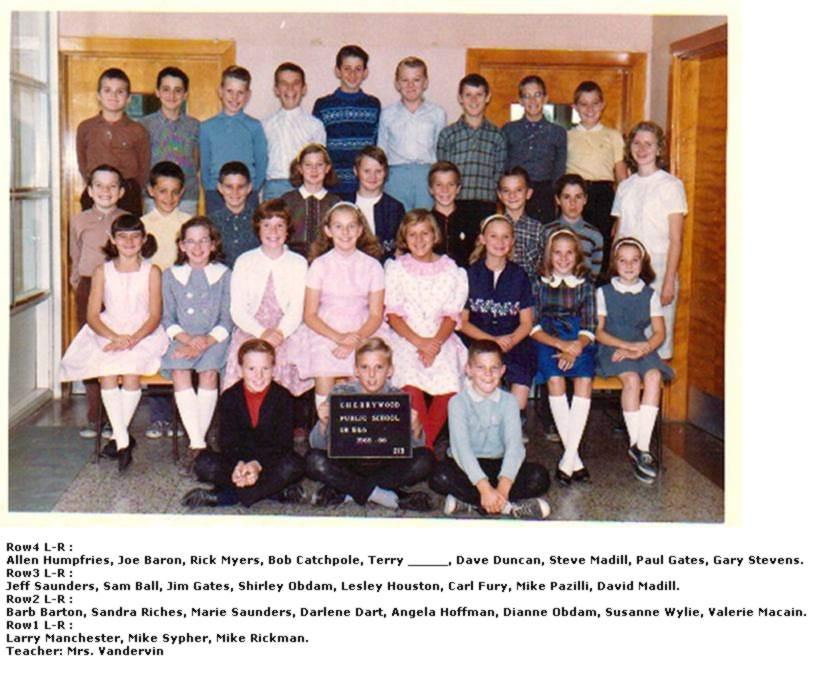
Cherrywood Class of 65-66 Grade 5-6

Well . . . Here's a more recent class picture that more of you may recall. With an ENORMOUS amount of help from Jeff Saunders, we have been able to come up with most of the names. If you have any idea who the "Missing Name" is, please let me know.
Thanks Jeff ! You remembered most of them !

Tuesday, September 20, 2005

Fall Photo in Cherrywood

Looking towards the east from town in the fall.

Monday, September 19, 2005

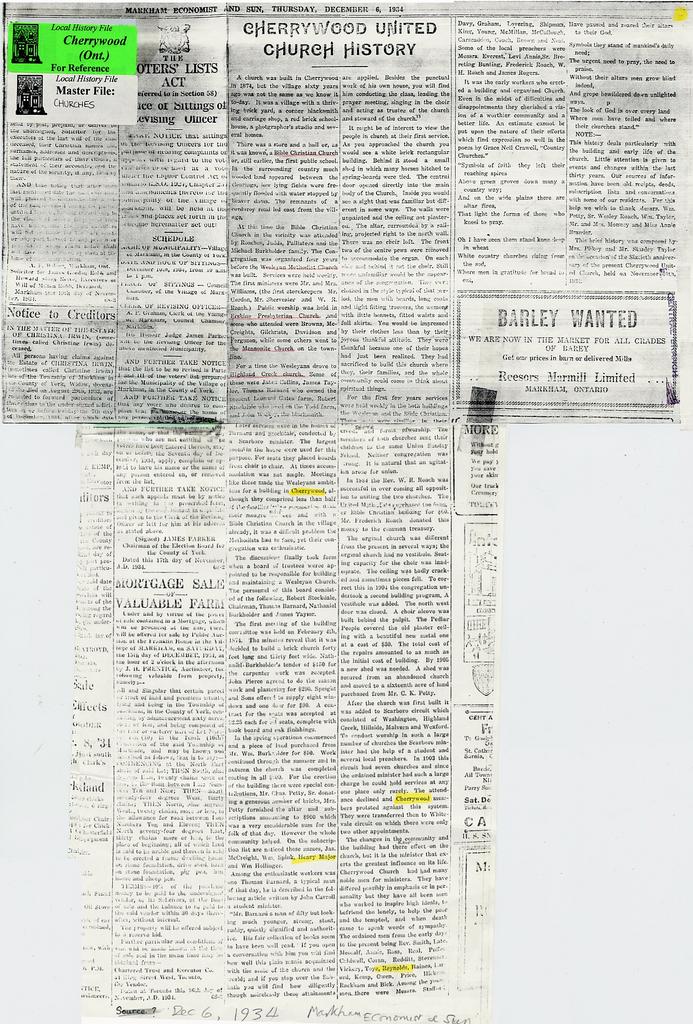
More on the Church and its History


Newspaper article copied from the MARKHAM ECONOMIST AND SUN, Thursday, December 6, 1934.

CHERRYWOOD UNITED CHURCH HISTORY

A church was built in Cherrywood in 1874, but the village sixty years ago was not the same as we know it to-day. It was a village with a thriving brick yard, a corner blacksmith and carriage shop, a rod brick school-house, a photgraphor's studio and several homes.

There was a store and a hall or, as it was known, a Bible Christian Church or, still earlier, the first public school. In the surrounding country much wooded land appeared between the clearings, low lying fields were frequently flooded with water stopped by beaver dams. The remnants of a corduroy road led east from the village.

At this time the Bible Christian Church in the vicinity was attended by Roaches, Judds, Pallisters and the Michael Burkholder family. The Congregation was organized four years before the Wesleyan Methodist Church was built. Services were held weekly. The first ministers were Mr. and Mrs. Williams, (the first storekeepers Mr.Gordon, Mr. Shervester and W. R. Roach.) Public worship was held in,Erskine Presbyterian Church, and some who attended were Browns, Mc-Creights, Gilchrists, Davidson and Ferguson, while some others went to the Mennonite Church on the town-line.

For a time the Wesleyans drove to Highland Creek church. Some of these were Jabez Collins, James Taylor, Thomas Barnard who owned the present Leornard Gates farm, Robert Stockdale who lived on Todd farm,and John Wilkey, the blacksmith.

Later services were in the homes of Barnard and Stockdale, conducted bya Scarboro minister. The largest rooms in the house were used for this purpose. For seats they placed boards from chair to chair. At times accommodation was not ample. Meetings like these made the Wesleyans ambitious for a building in Cherrywood, although they comprised less than half of the familes in the community with their meagre [?] and with a Bible Christian Church in the village already, it was a difficult problem the Methodists had to face, yet their congregation was enthusiastic.

The discussions finally took form when a board of trustees were appointed to be responsible for building and maintaining a Wesleyan Church The personnel of this board consisted of the following, Robert Stockdale, Chairman, Thomas Barnard, Nathaniel Burkholder and James Taylor.

The first meeting of the building committee was held on February 4th, 1874. The minutes reveal that it was decided to build a brick church forty feet long and thirty feet wide. Nathaniel Burkholder's tender of $150 for the carpenter work was accepted. John Pierce agreed to do the mason work and plastering for $290. Speight and Sons offered to supply eight windows and one door for $90. A contract for the seats was accepted at $2.25 each for [90]seats, complete with book board and oak finishings.

In the spring operations commenced and a piece of land purchased from Mr. Wm. Burkholder for $50. Work continued through the summer and in autumn the church was completed costing in all $800 For the erection of the building there were special contriubtions, Mr. Chas. Petty, Sr. donating a generous number of bricks, Mrs. Petty furnished the altar and subscriptions amounting to $900 which was a very considerable sum for the folk of that day. However the whole community helped. On the subscription list are noticed these names, Jas. McCreight, Wm. Spink, Henry Major and Wm Hollinger.

Among the enthusiastic workers was one Thomas Barnard, a typical man of that day, he is described in the following article written by John Carroll a student minister.

"Mr. Barnard a man of fifty but looking much younger, strong, stout, ruddy, quietly dignified and authoritive. His fair collection of books seem to have been well read. If you open a conversation with him you will find how well this plain man is acquainted with the state of the church and the world; and if you stop over the Sabbath you will find how diligently though noislessly these attainments are applied. Besides the punctualwork of his own house, you will find him conducting the class, leading the prayer meeting, singing in the choir and acting as trustee of the church and steward of the church.”

It might be of interest to view the people in church at their first service. As you approached the church you would see a white brick rectangular building. Behind it stood a small shed in which many horses hitched to springboards were tied. The central door opened directly into the main body of the Church. Inside you would see a sight that was familiar but different in some ways. The walls were unpainted and the ceiling not plastered. The altar, surrounded by a railing, projected right to the north wall. There was no choir loft. The front two of the centre pews were removed to accommodate the organ. On each side and behind it sat the choir. Still more unfamiliar would be the appearance of the congreagation. They were clothed in the style typical of that period, the men with beards, long coats and tight fitting trousers, the womens with little bonnets, fitted waists and full skirts. You would be impressed by their clothes less than by their joyous thankful attitude. They were thankful because one of their hopes had just been realized. They had sacrificed to build this church where they, their families, and the whole community could come to think about spiritual things.

For the first few years services were held weekly in the both building the Wesleyan and the Bible Christian. These sects were similar in their creeds and form of Worship. The members of both churches sent their children to the same Union Sunday School. Neither congregation was strong. It is natural that an agitation arose for union.

In 1884 the Rev. W. R. Roach was successful in over coming all opposition to uniting the two churches. The United Methodist purchased the former Bible Christian building for for $60. Mr. Frederich Roach donated this money to the common treasury.

The original church was different from the present in several ways; the original church had no vestibule. Seating capacity for the choir was inadequate. The ceiling was badly cracked and sometimes pieces fell. To correct this in 1904 the congregation undertook a second building program. A vestibule was added. The north west door was closed. A choir alcove was built behind the pulpit. The Pedlar People covered the old plaster ceiling with a beautiful new metal one at a cost of $30. The total cost of the repairs amounted to as much as the initial cost of building. By 1905 a new shed was needed. A shed was secured from an abandoned church and moved to a sixteenth acre of land purchased from Mr. C. K. Petty.

After the church was first built it was added to Scarboro circuit which consisted of Washington, Highland Creek, Hillside, Malvern and Wexford. To conduct worship in such a large number of churches the Scarboro minister had the help of a student and several local preachers. In 1903 this circuit had seven churches and since the ordained minister had such a large charge he could hold services at any one place only rarely. The attendance declined and Cherrywood members protsted against this system. They were transferred then to Whitevale circuit on which there were only two other appointments.

The changes in the community and the building had there effect on the church, but it is the minister that exerts the greatest influence on its life. Cherrywood Church had had many noble men for ministers. They have differed possibly in emphasis or in personality but they have all been men who worked to inspire high ideals, to befriend the lonely, to help the poor and the tempted, and when death came to break words of sympathy. The ordained men from the early day to the present being Rev. Smith, Late. Metcalf, Annis, Ross, Real, Puffer, Caldwell, Coran, Redditt, Stevenson Vickery, Toye, Reynolds, Haines, Larord, Kemp, Owen, Price, Hickson, Rackham and Bick. Among the young men there were Messrs. Stafford, Davey, Graham, Lovering, Shipman, King, Young, McMillan, McCullough, Carscadden, Couch, Brown, and Neal. Some of the local preachers were Messrs. Everest, Levi Annis Sr. Brereting Bunting, Frederick Roach, W. H. Roach and James Rogers.

It was the early workers who erected a building and organized Church. Even in the midst of difficulties and disappointments they cherished a vision of a worthier community and a better life. An estimate connot be put upon the nature of their efforts which find expression so well in the poem by Grace Nell Farewell , "County Churches."

Symbols of faith they left their reaching spires.
Above green grove sdown many a country way;
And on the wide plains there are altar fires,
That light the forms of those who kneel to pray.

Oh I have seen them stand knee deep in wheat
White country churches rising from the sod,
Where men in gratitude for bread to eat,
Have paused and reared their altars to their God.

Note: This history deals mainly with the building and earlllly life of the church. Little attention is given to events and changes within ghe last thirty years. Our sources of imformation have been old recipts, deeds, subscription lists and conversations with some of our residents. For this help we wish to thank Messrs. Wm. Petty,Sr., Wesley Roach, Wm. Taylor. Mr. and Mrs. Monney and Miss Annie Brander. This brief history ws composed by Mrs. Pilkey on the occasion of the Sixteenth anniverdary of the present Cherrywood United Church, held on November 10th, 1934.

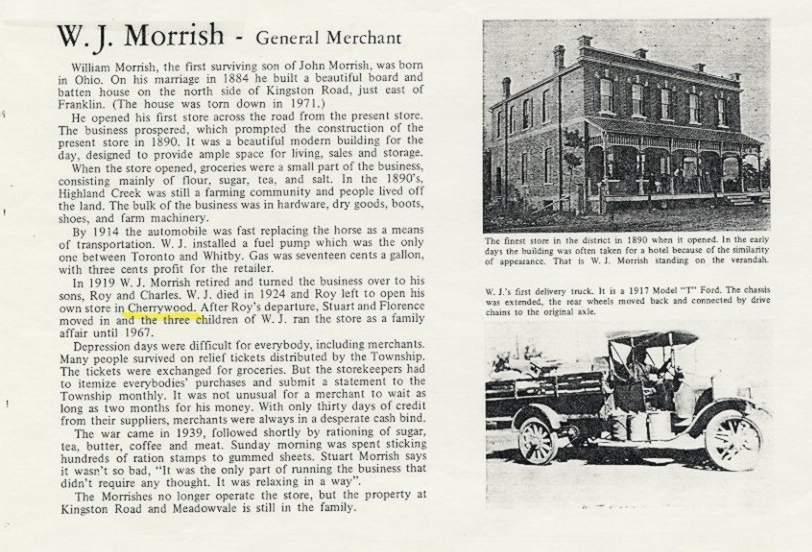
Cherrywood Founder

Andrew McCreight came from Ireland in 1835. He had three sons, James, John and Andrew. James came to Cherrywood in 1833 and married Mary Ann Brown, who also came from Ireland. He was born in 1814 and died in 1895. He was a staunch member of the Erskine Presbyterian church. Names of the children who attended Cherrywood school: Maria, Jane, Margaret, Sarah, Isabella and Elizabeth. He served as Reeve of the township for a number of years and also served in the county council. He was Justice of the Peace for a number of years. He bought the farm for six hundred dollars. The north part he bought from Mr. Shunk from Vaughan, Ernest Armstrong, his grandson occupies the farm at the present time. He was one that favored higher education and three of his daughters were teachers and two helped to keep the home. They were six weeks sailing from Ireland to Canada. Cherrywood was named after Squire McCreights birth place in Ireland.

Cherrywood Store Owner's

Cherrywood store was built in 1872 by Charles Petty Sr. Names of the store keepers were Williams, Cranson, Murray Summerfelt, Alfred McPherson, John Green, Tom Robins, Thomas Law, Robert Davidson and Roy Morrish.

Friday, September 16, 2005

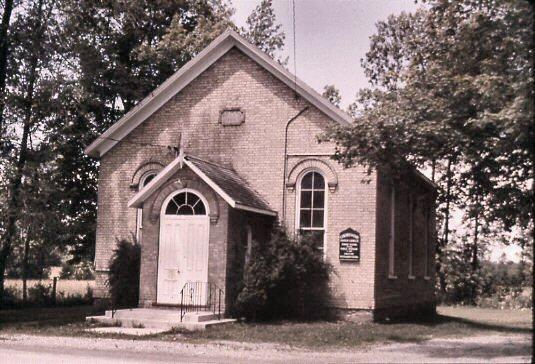
Cherrywood Church

To build a church in a rural community is no easy task. To build a Methodist church in a community where most people attended churches of other sects is still harder. But that is the way the early Wesleyan Methodist in Cherrywood did. The present congregation is remembering these enterprising people in the services of the sixteenth anniversary of the church. Before they built their church they held services in their homes or travelled the rough roads in spring boards to Highland Creek where the nearest Methodist church was located.

By 1874 the early Methodists were convinced that the community would be a better place to live in if they had a church. The owner of the brick yard supplied the brick and his wife furnished the alter. The local merchant supplied the coal oil for the lamps. Members gave freely while canvassing neighbouring denominations. Finally the total cost of nine hundred dollars was raised and joyfully did the members meet for the first service of worship in their new church although it was not artistically perfect, but the simple rectangular building of white brick was beautiful to them.

In it they saw the work of their own hands through self sacrifice and hopes for a fuller and better community life. Thirty years afterwards they made necessary improvements, an alcove at the front for the choir and a vestibule at the back. A special shed removed from an abandoned church was set up to accommodate the many rigs. The improvements in the church and the early growth of the congregation was made possible by the church union in 1864 when the Bible Christians joined with the Methodists. This anniversary was an occasion to pay tribute to the memory of the early church workers.

Services to mark the anniversary were held the next Sunday at 2.30 o'clock and the speaker was Rev. Mr. Lawrence of Washington church, Scarborough and at 7.30 p.m. the speaker was Rev. Mr. McDonald, chairman of Toronto East Presbyterian church, assisted by the choir of the Centennial church in Scarborough. Names of choir members: Mary Jane Barnard, first organist, Ambrose Barnard, Sinclair Barnard, Miss Emmaline Burkholder, Miss Stouffer, Daniel Hoover, Mr. and Mrs. Nathaniel Burkholder and Miss Emily Taylor.

Names of the ministers were H.C. Ross, J.R. Real, J. W. Puffer, Rev. Dick, J.T. Caldwell, H.B. Conron, J.J. Redalitt, G. W. Stevenson, John Vickery, R.E. Loye, Wm. Neal, Levi Annis, Rev. Carscadden, Rev. Moore, Rev. Lunau, Rev. Legget and Rev. Rennold which bring it up to 1908. Rev. Lake had a very successful revival meeting after the church was built. Rev. Mr. Kennedy of Peterboro held a revival meeting around 1900 which proved a success.

The Erskine Presbyterian church was built in 1853. It was the first church in the section and was used for a number of years but the congregation later worshipped at Dunbarton. There is one service on the third Sunday of June in remembrance of the old pioneers that are buried in the cemetery. It is one of the best kept up cemeteries in the township. They also gathered up the tombstones of some of the old settlers who were buried on their farms, and placed them in the cemetery which is a credit to any cemetery.

The next oldest church is the Reesor Mennonite church which was built on Rev. John Eby Reesors farm in 1857. Before this they worshipped in a log school house which stood on the corner of Lot 1, concession 1, at the very edge of Markham township and before that they worshipped in their homes. Their last house meetings were held in Samuel Reesors home every Christmas Day as it was his birthday and nearly everyone stayed for dinner. The cemetery at Cedar Grove is one of the oldest cemeteries where a lot of the old settlers are buried.

Cherrywood Garage


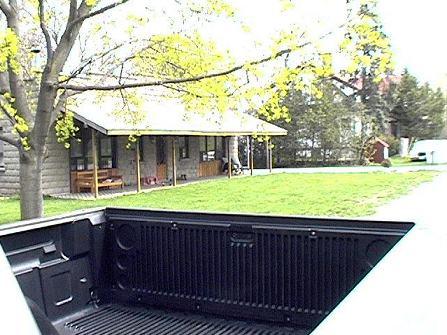
Some of you may be able to recall when this was a gas station.


Currently the old garage in being used as a residence.


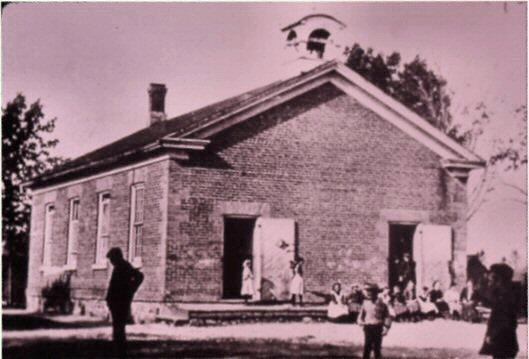
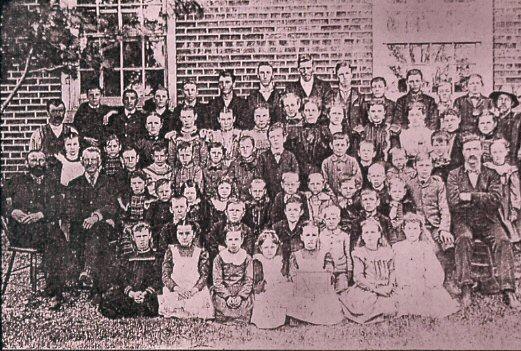
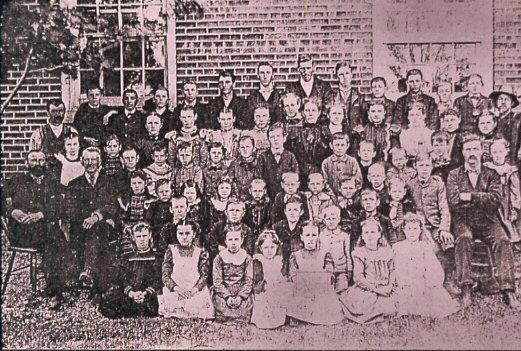
Cherrywood Class Picture

This was Cherrywood School house in 1908.
Correction: This photo was taken in 1908, not 1850 as first indicated. (thanks to the information received from Bob Morrish).

Recongnize anyone in this Class Picture ? This was taken in 1900.

Petticoat Creek CNR Bridge


Photocopy of the C.N.R. bridge over Petticoat Creek at Cherrywood, Ont. This was a post card that was issued in 1911.

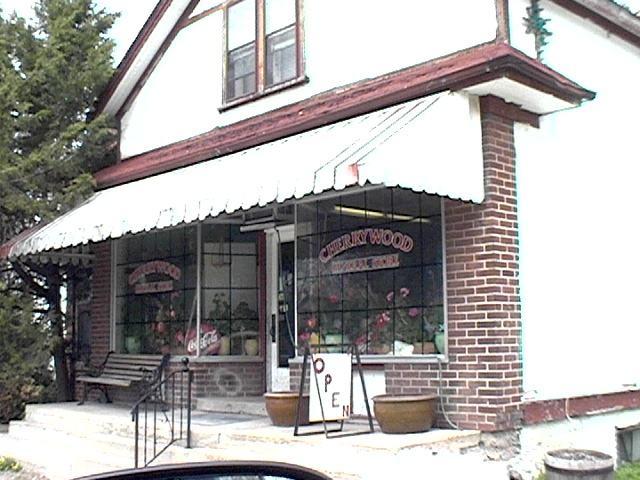
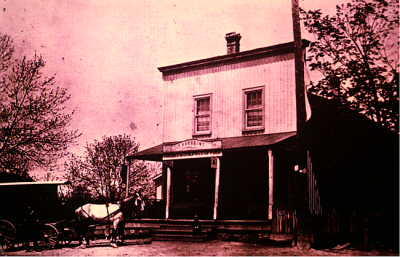
Cherrywood Store

This Photograph was taken in 1970 when it was owned and operated by Roy Morrish & Son.

I am not sure of the date of this photograph, but this was the store when it was been managed by T.P Robbins. It was the the Post Office as well. Based on the horse and wagon outside, it must have been a while ago

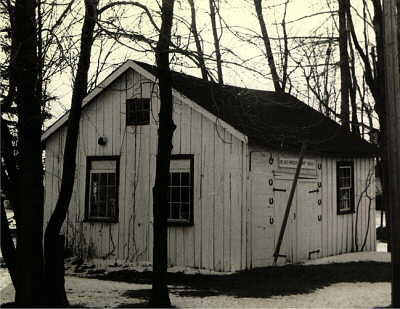
Blacksmith's Shop, Cherrywood


From what I can recall, this was across the road from the store.
This is a black & white photograph of a building in Cherrywood that had been the blacksmith shop. John Petty built the blacksmith shop in 1912 to serve the horses that delivered milk to the trains. From what I can recall, this was across the road from the store.

Pickering Township 1967


This is a posting of a small portion of a map of the Township of Pickering in 1967 which includes the various property owners. What you see here is only a small portion of the map. If you would like a digital copy of it complete, just email me. I would be more then happy to send a full version.